Note: This post contains affiliate links. You may read my disclosure here.
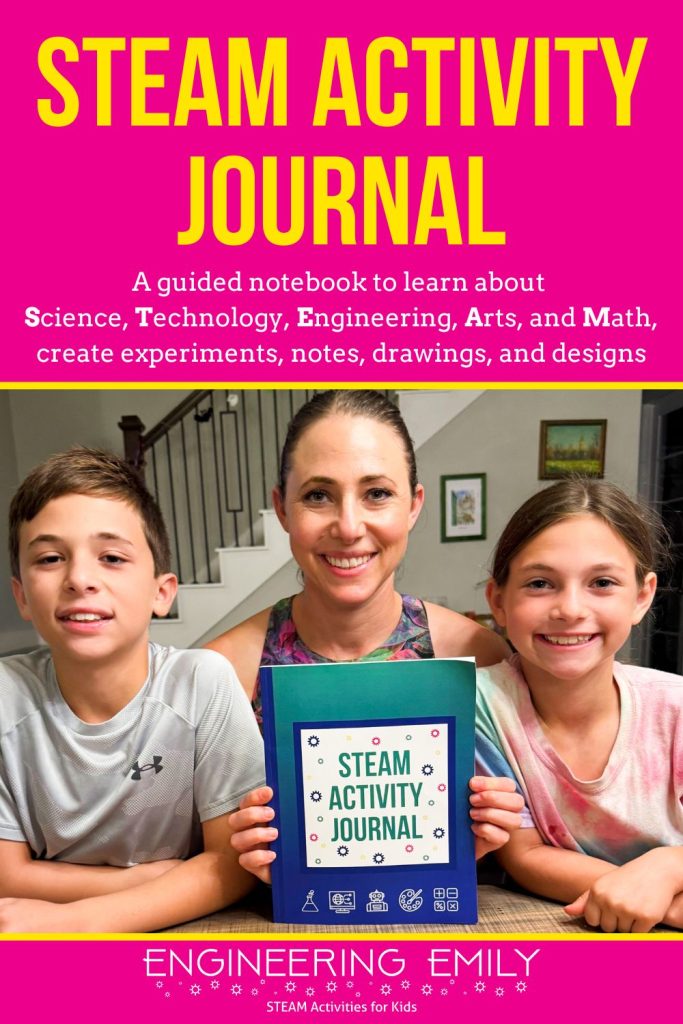
I FINALLY DID IT! I PUBLISHED MY FIRST BOOK!!!
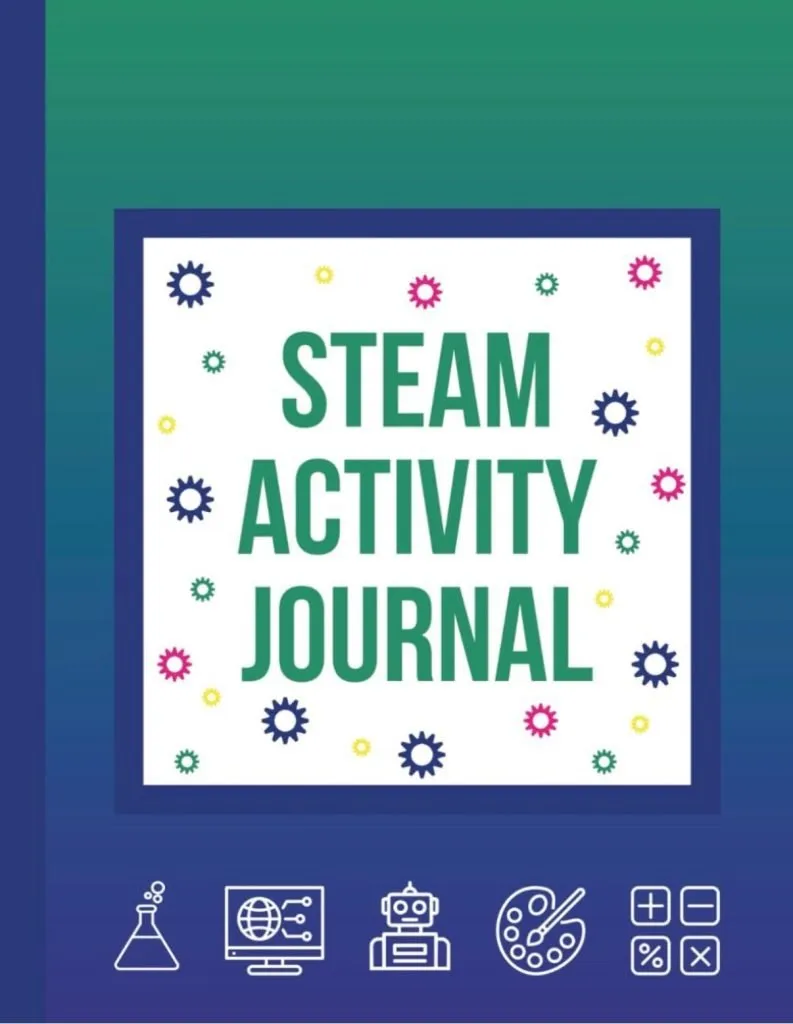
My book is called the STEAM Activity Journal: A guided notebook to learn about Science, Technology, Engineering, Arts, and Math, create experiments, notes, drawings, and designs.
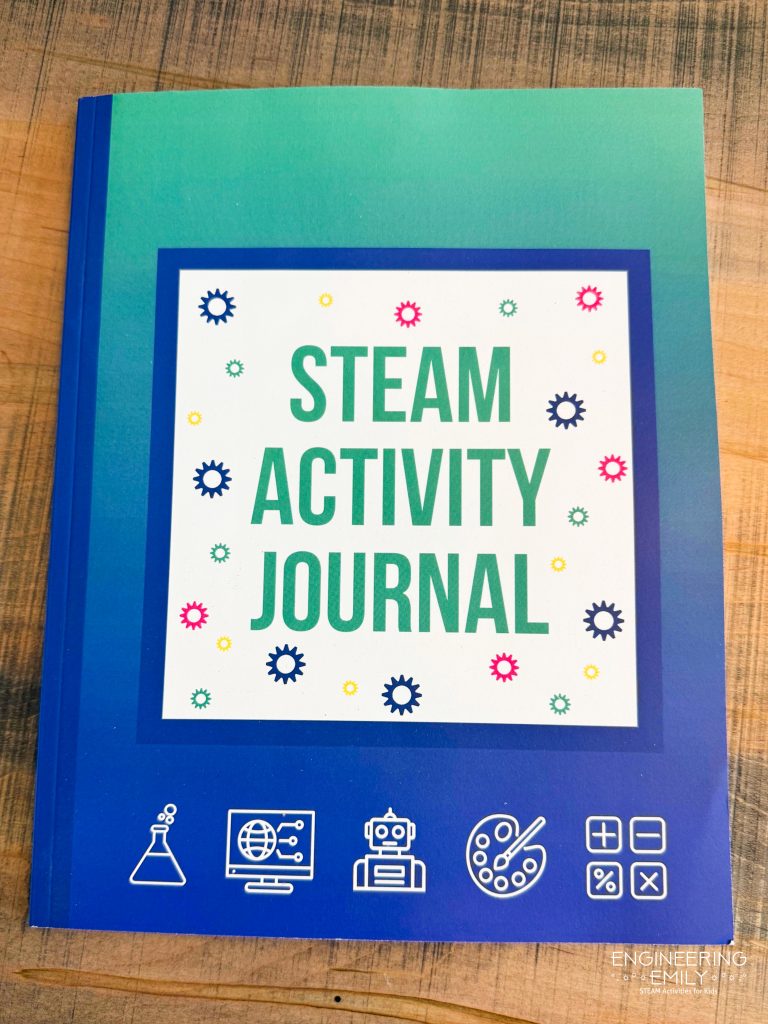
It’s written, designed, edited, and published all by ME! I got to combine my love of all things STEAM, with my passion for writing, and my graphic design background create this very special journal.

If you’ve been following me here on Engineering Emily for awhile you will know it’s been a dream of mine for the last 5 years to write and publish a book. My initial goal was a STEM/STEAM themed picture book for kids. As I’ve focused more on sharing STEM/STEAM Activities and experiments for kids I changed my goal to creating either or an experiment book or a companion journal.
I offer STEAM Activity Printables in my Shop, which can be printed and turned into a “book” at home, but alas – you can also find all those activities for free on my website, so they haven’t been selling. I knew it was time to pivot.
Why a Journal?
My kids are HUGE fans of journals and for the past few years I’ve spent more money on journals and diaries than books at their school book fairs. That got me thinking that a STEAM guided journal would be a fun idea.
I eventually had the idea to offer a journal as a companion to the STEAM activities and experiments. The STEAM Activity Journal a guided journal to document what you are doing during the activities. It’s a great opportunity for your kids to take more ownership of the experiments, they can document each step of the experiment, and think more about what happened and how to improve the activity when they try it again.

With the STEAM Activity Journal, kids get the unlimited possibilities of a blank journal, but it also provides some guidance for those who need a starting place for their writing. I’m the type who often needs a push or prompt to get started, and then I can let my knowledge and imagination push me from there. That’s what I hope this journal provides.
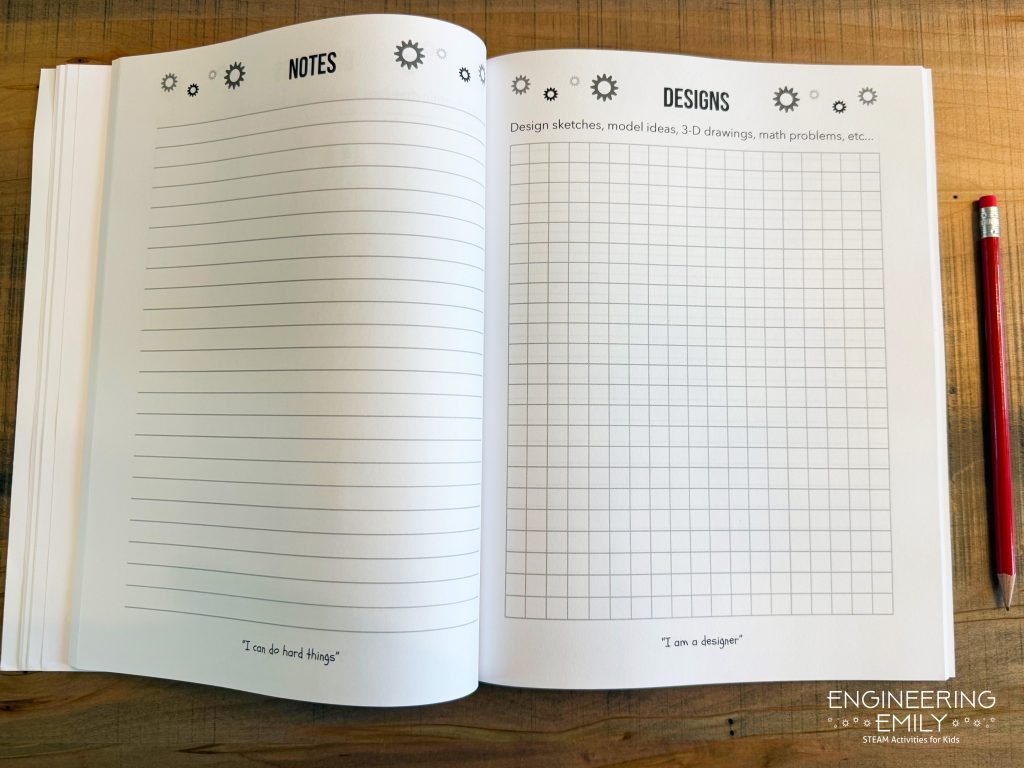
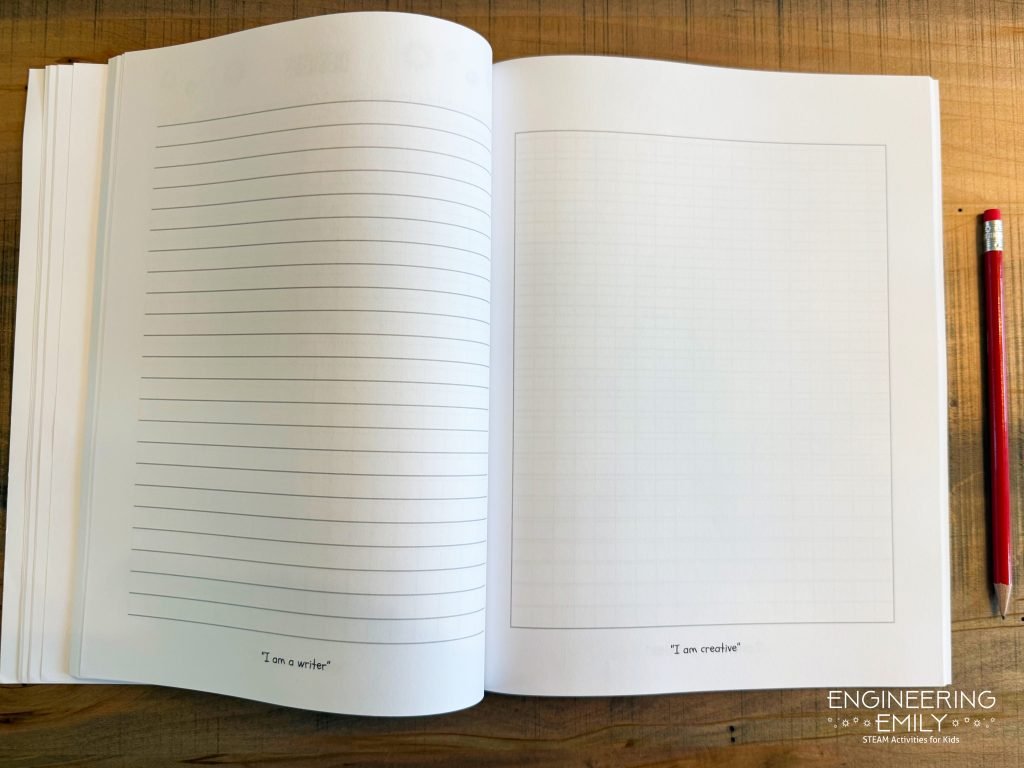
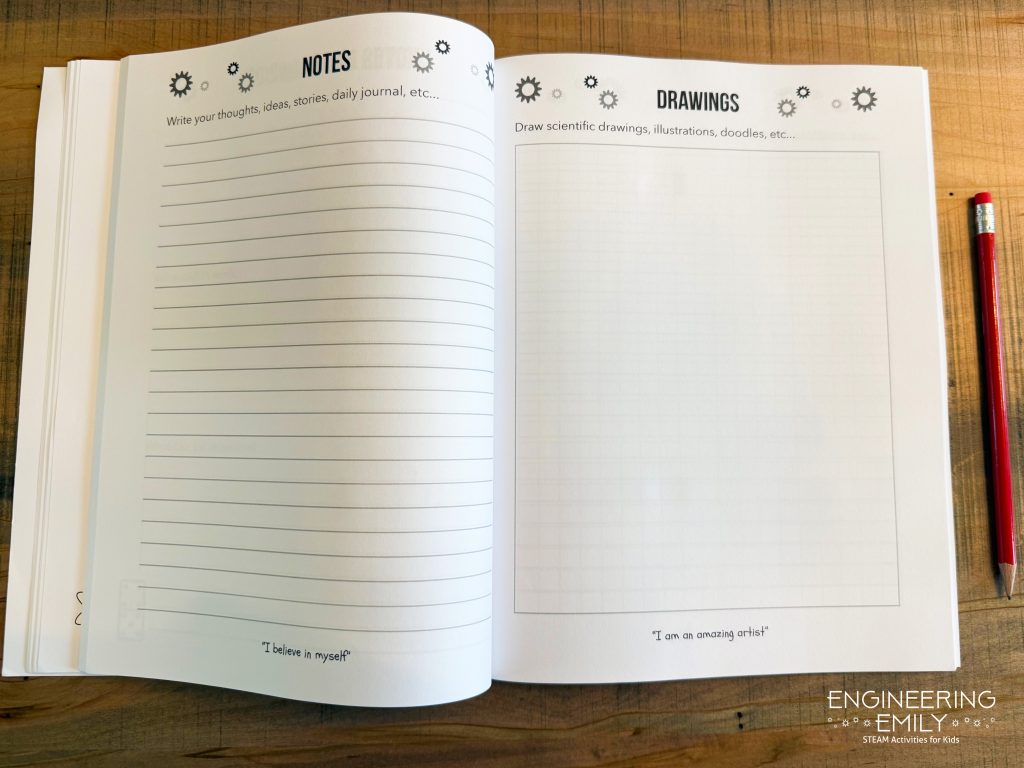
And if kids prefer to draw over write, there are plenty of open, unlined pages to draw too! And as a final special touch from the engineer in me, I added grid pages. It’s all I used in engineering school – everything was due on engineering paper (if you haven’t seen it before, engineering paper is green tinted and has a dark grid on the back, with a faint grid showing through to the front). I used it for writing, and solving math and engineering problems. Grid paper provides guides for those of us who like perfect lines and spacing, and in this journal the grid is light gray, so you also have the freedom to go outside those lines and draw or write whatever you want over the grid.
Who is it for?
I recommend the STEAM Activity Journal for curious kids ages 8-14. My older kids are 8 and 11, and they are perfect ages to use this journal. We have been using it together and they really enjoy it (cue the proud mom tears).

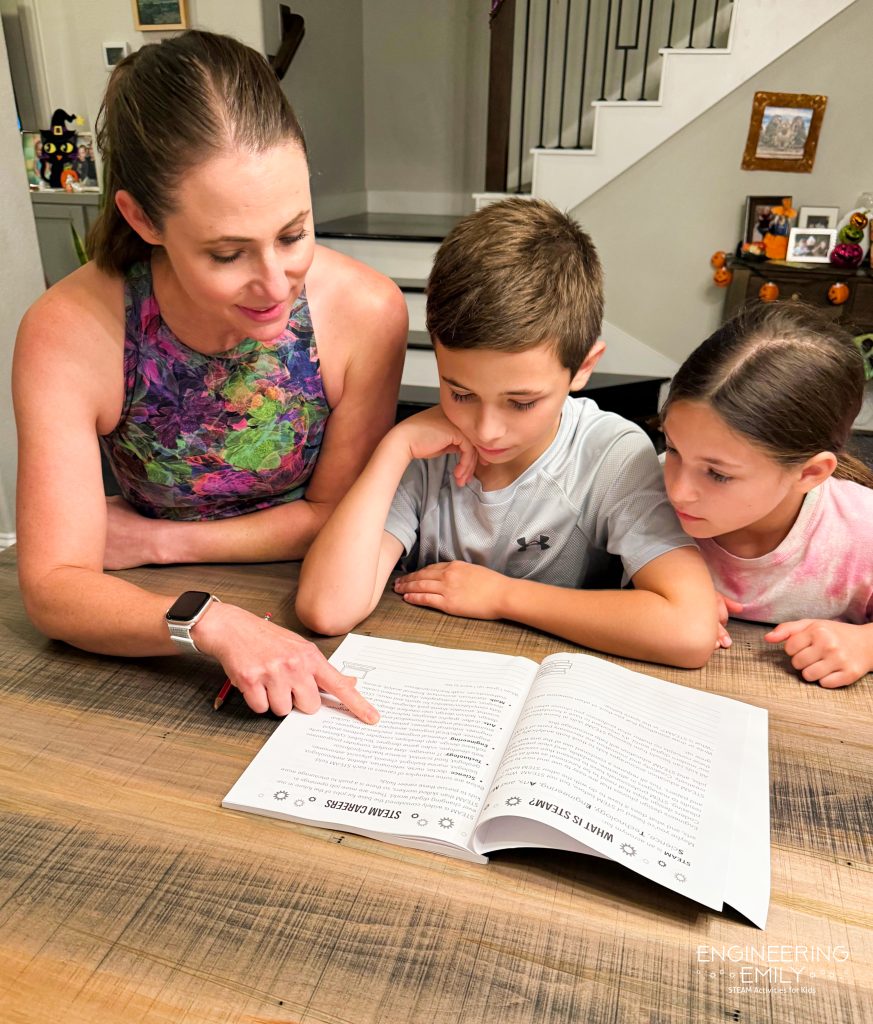
There is a lot of text to read in the beginning of the book, and this is a good opportunity for you to spend quality one on one time with your child. With younger children (8-10), you read the pages and work through and discuss the prompts together. Older kids (10+) can likely do everything in the book independently. I like to let my kids start off on their own, then offer encouragement and support where needed.
The notes, drawings, and design pages are all completely open ended and can be filled in independently by the child. So whether you enjoy helping your child and spending that 1:1 time with them, or you would rather they work alone, there is plenty for them to do in this book.

What You Will Find Inside
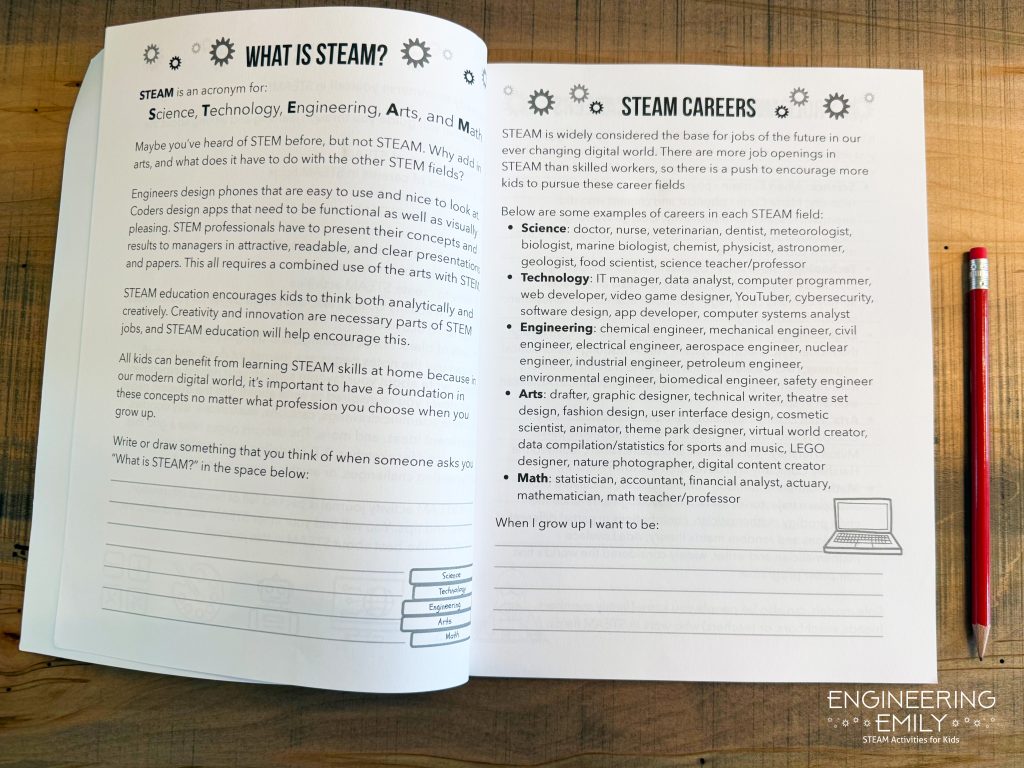
The STEAM Activity Journal begins with an explanation of the meaning of STEAM, and why it’s important for kids to learn and succeed these subjects. That flows into an explanation of why many STEAM careers are in high demand, gives examples of STEAM careers, and encourages kids to think about what career interests them.
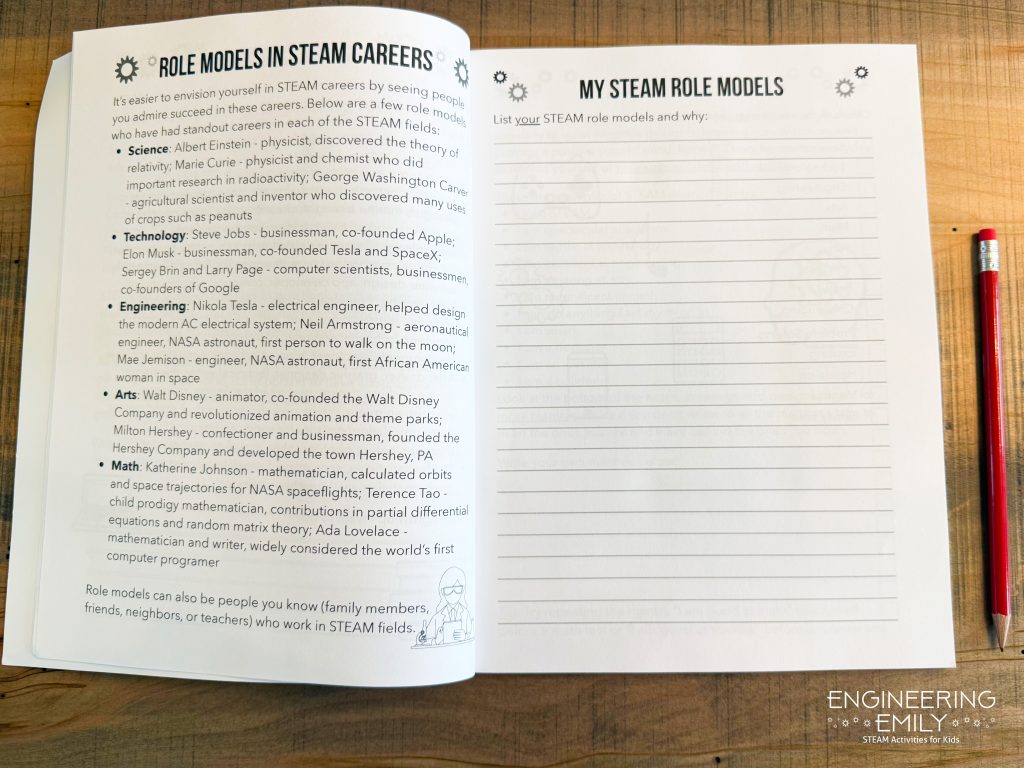
Next, I share why it’s important to have role models who you admire in professions you’re interested in. I give examples of role models who have stand-out careers in each STEAM field, then encourage kids to think of their own role models and research and write about them. I think the best role models are people children know and admire: like family members, teachers, and neighbors.
I have a page called “Why I like STEAM”, which helps kids think about what they like about STEAM. Is it the science, art, math, or because it’s fun, challenging, etc? Best of all, it’s a checklist because checklists are whimsy and fun! In my proof copy, I checked all the options because I love everything about STEAM and it’s just so satisfying to put a check in an empty box. 🙂
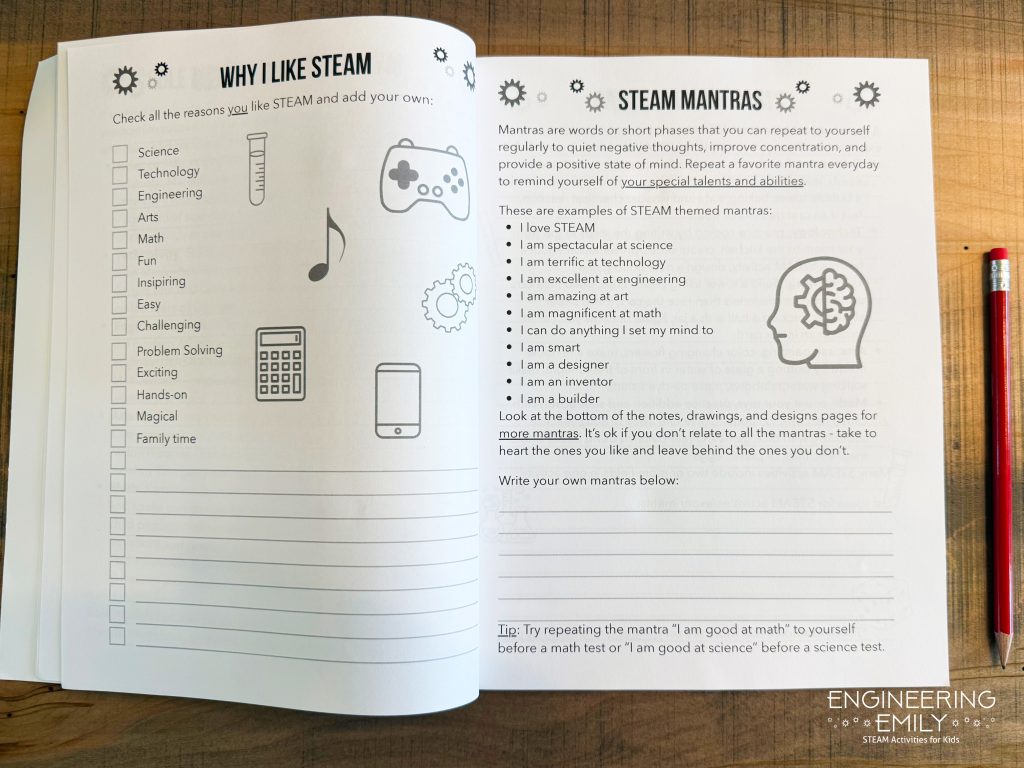
My favorite page in the STEAM Activity Journal is the STEAM mantras pages. The mantras page teaches kids to repeat positive sayings to themselves to remind themselves of their special talents and abilities.
When I was growing, up my mom often told me I was good at math and that really helped me believe it myself. I never struggled in math because I believed I could do it. I’ve continued the tradition of using the math mantras with my own kids. Now, when my middle schooler is nervous before a big math test we yell together, “I AM GOOD AT MATH!” until I’m sure he believes it, and then he goes on to take his math test with confidence rather than fear or nervous energy.
Since I didn’t have enough room to share all the mantras I’ve used and recommend on the mantras page, I added additional mantras to the bottom of all the Notes, Drawings, and Design pages. Each of those pages has a unique mantra on them, and I hope all kids who read this journal will find a mantra that inspires them and boosts their confidence.
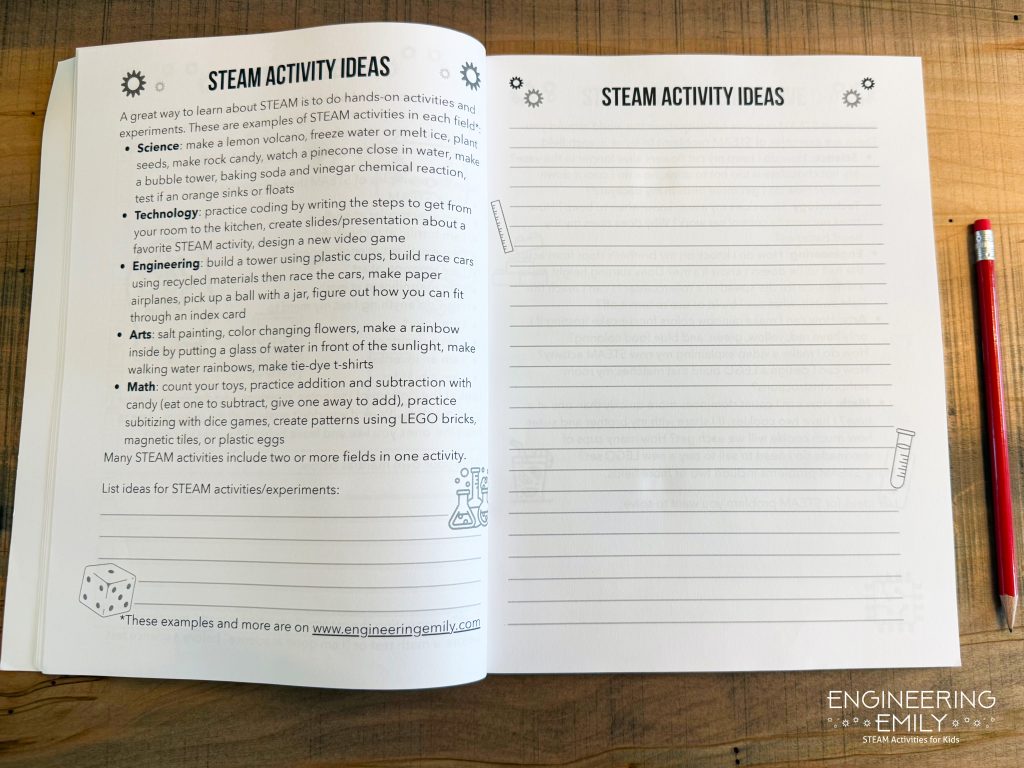
Next, I list STEAM activity ideas (all of which can be found on this blog), and there is a page for kids to write their own ideas, activities they are interested in trying from my list, or activities that they’ve seen elsewhere.
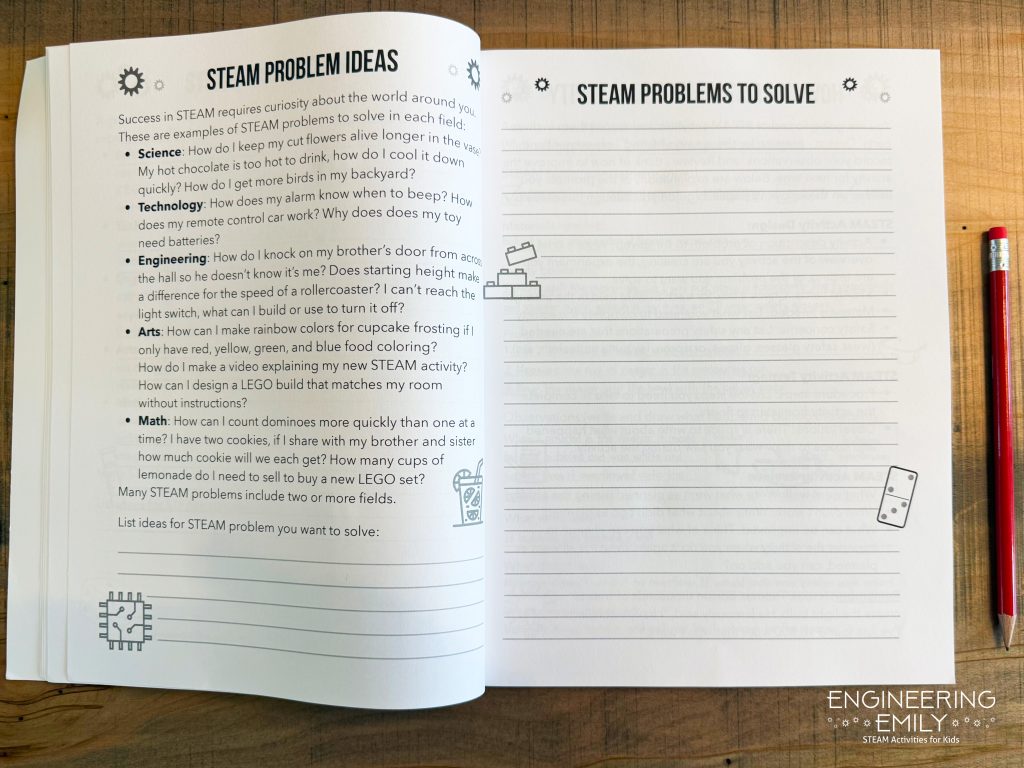
In addition to STEAM activity ideas, I also share STEAM problem ideas. These are questions that curious kids might wonder and want to find the answer to. I list several ideas in each subject, then provide a page for kids to write their own ideas for problems to solve, or write the problems from my list they are interested in finding the answer to.
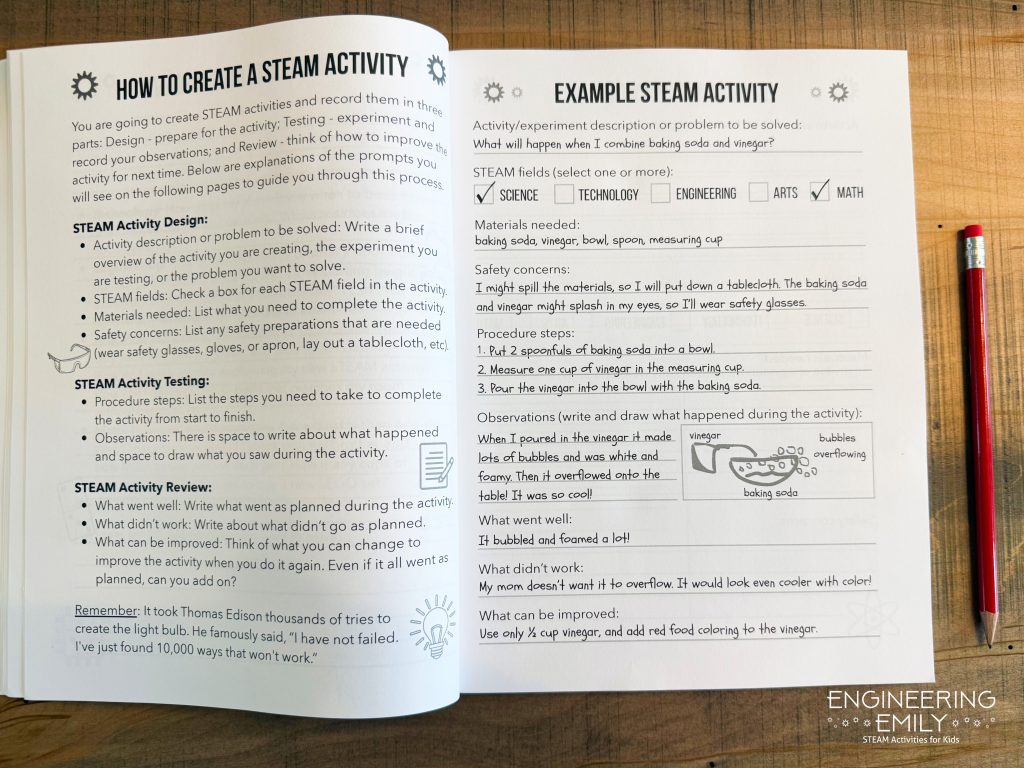
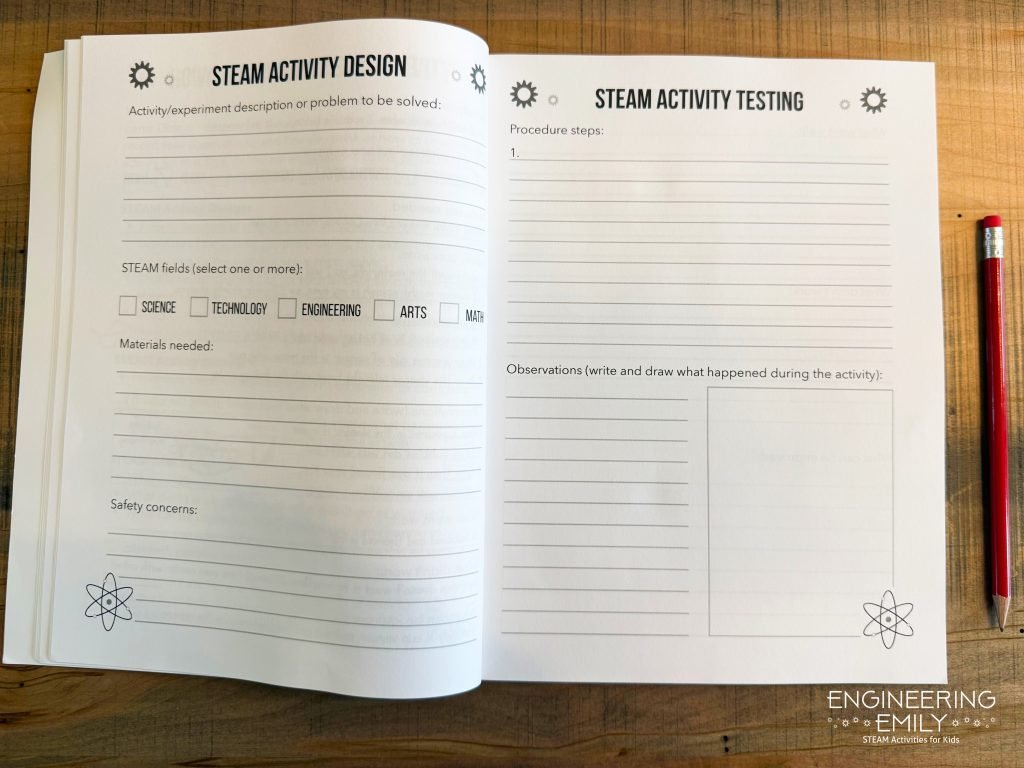
The real “meat” of the book is the STEAM Activity pages. I explain how kids can create their own STEAM activities (or they can work on experiments from my blog), I provide a completed example, and then there are guided pages for kids to complete and document up to 10 activities.
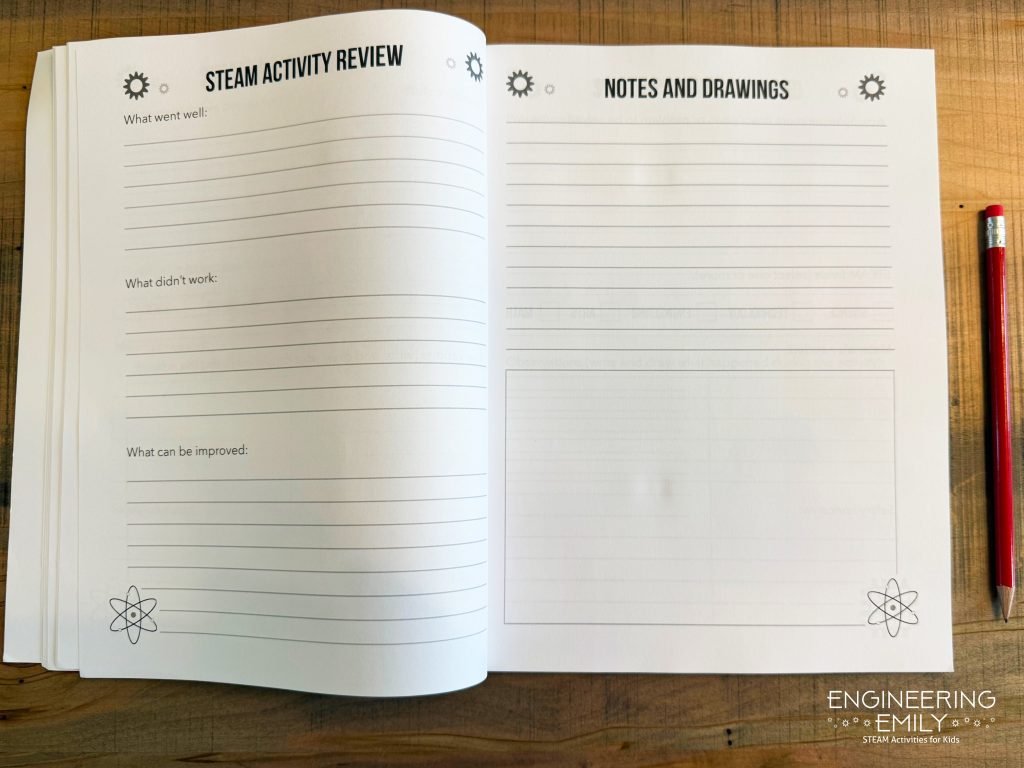
Finally, there are plenty of extra blank Notes, Drawing, and Design pages. These pages can be used for any writing, drawing, or designing kids can imagine. They can write more about their STEAM experiments, they can write and illustrate a real or fictional story, they can write about their dream rollercoaster or video game and then use the design pages to draw it, they can use it as a daily journal, the possibilities are endless!
Go Buy a copy!
If all of this sounded interesting and exciting to you, please consider purchasing a copy of my STEAM Activity Journal. It is currently for sale for Amazon (with free shipping 2 day with an Amazon Prime account). There is a paperback version for $9.99 and a hardcover version for $17.99 (all photos in this post are the paperback version).
Thank you so much for supporting my blog and my dream of publishing a book!

If you purchase the STEAM Activity Journal I’d love to know what you and your kids think about it. ***PLEASE CONSIDER LEAVING A REVIEW on Amazon. Reviews make a huge difference as far as visibility on Amazon, and helps others decide whether or not to buy the book. THANK YOU!!!***
Make sure you’re following my @engineering_emily Instagram account because I will be doing several STEAM Activity Journal giveaways! I’d like to get the journal to as many of you as possible. 🙂

Do you like the idea of the STEAM Activity Journal? I’d love to know your honest thoughts about it because I have several more variations in mind (STEM, science, math, high school version, younger kids version, etc) I’d like to publish eventually and it’d be great to know if there is interest!